
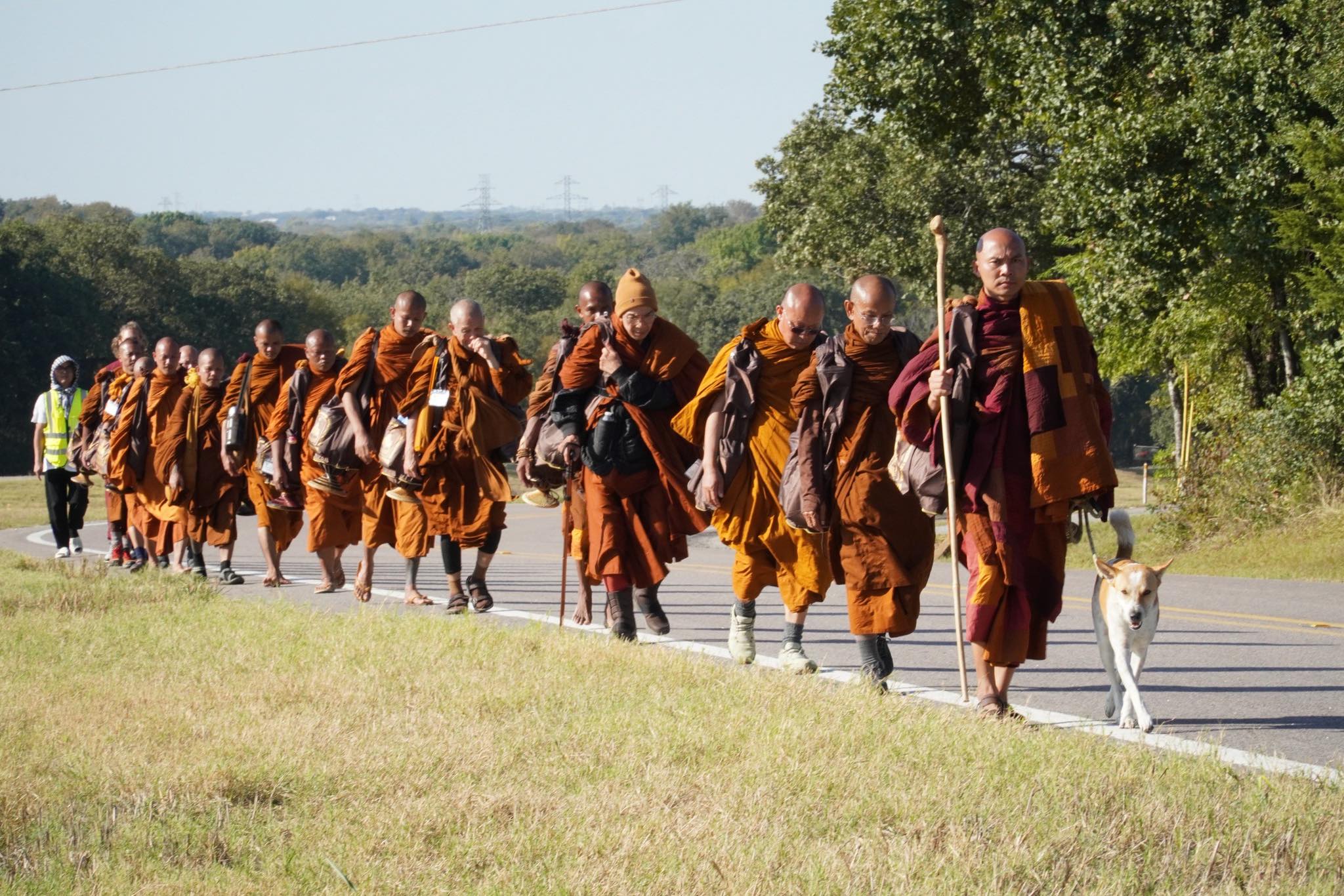
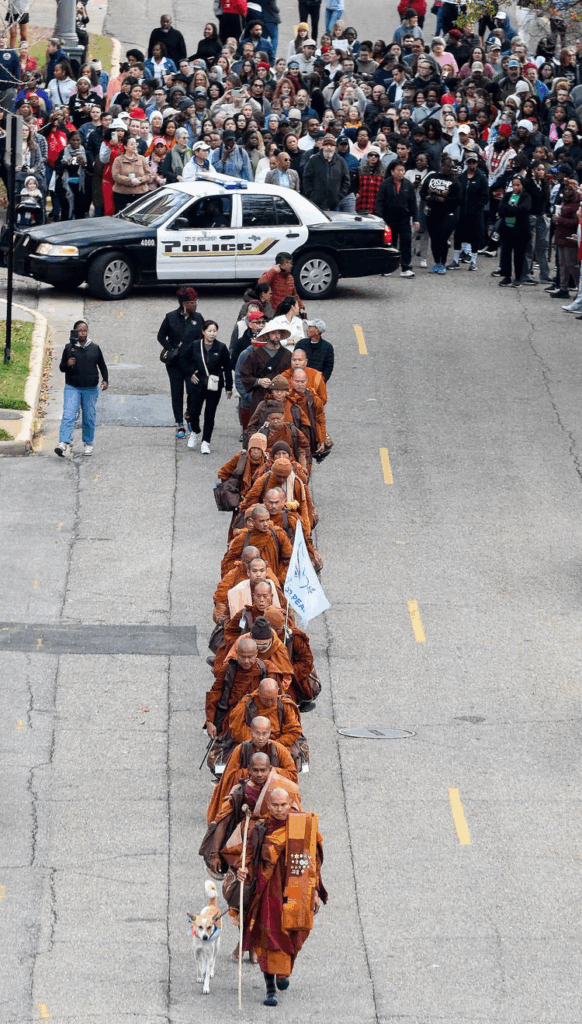
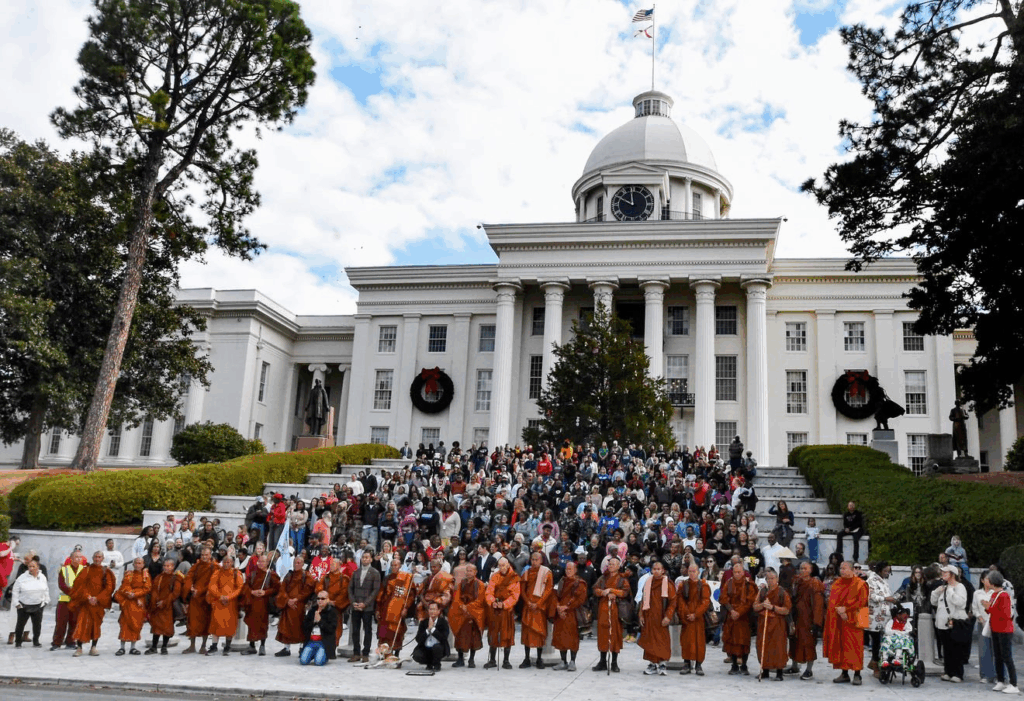
There’s a group of Buddhist monks currently walking from Texas to Washington, DC. They aren’t carrying signs. They aren’t selling anything. They aren’t explaining themselves upfront. They are walking – slowly, publicly, and peacefully – mile after mile. And somehow, in a world saturated with content, they’ve captured attention in a way most brands never do. From a branding perspective, this isn’t accidental. It’s instructive. Since October, they’ve garnered 362K followers on Facebook alone for their Walk for Peace page – and they’re only halfway through their journey.


There’s something about this moment that feels oddly familiar – almost cinematic. It carries echoes of Forrest Gump – that quiet, unassuming journey across America that somehow becomes a mirror for the nation itself. No manifesto. No agenda. Just movement. Presence. Endurance. And a growing crowd of people who don’t fully understand what they’re witnessing, but feel compelled to follow it anyway.
It’s also reminiscent of the Netflix series Messiah, which explored what might happen if a spiritual figure appeared in modern times – not with spectacle or certainty, but with ambiguity, humility and actions that stirred reflection rather than allegiance.
That’s the energy here. Not performative. Not self-declared. Not loud. Just people walking – and a country projecting meaning onto it. And that’s exactly what makes this such a powerful real-life cultural moment.
Because when something spreads like this – not through algorithms, not through ads, but through human curiosity and conversation – it’s worth paying attention.
Especially if you work in branding. Especially if your job is to understand how attention is earned, how trust is built and how meaning moves through culture. That’s when this stops being just a story –
and starts becoming a masterclass.
How This Came Across My Radar
There’s a common misconception that because I run this marketing and branding firm, I must know every trend, movement and viral moment happening on social media at all times. Clients think this. Even my own husband and sister think it!
But that couldn’t be further from the truth.
In reality, because I work in marketing and branding, I’m intentionally disciplined about not living inside social media. Platforms are designed to be addictive by nature. And if I (or my team!) spent my days swimming in feeds, chasing algorithms and absorbing everything being served to us, I’d never get any real work done – let alone the kind of deep, strategic thinking branding actually requires.
Social media is one facet of marketing. It is not everything nor is it the work itself. So, contrary to popular opinion (and hate to burst your bubble), but I don’t live, breathe or drink social media. Which is why I didn’t “discover” the Buddhist monks walking from Texas to Washington, DC the way my sister did. Instead, I heard about it the way a good chunk of us likely did – by word of mouth. Because a sister like mine told them. (And in case you haven’t heard, word of mouth is still one of the most powerful forms of marketing since the dawn of time).
The Organic Moment (This Is Important)
Like most things that truly break through, this didn’t come from my algorithm. It came from people. My husband sees a completely different feed than I do. My sister has her own algorithm entirely. Over the holidays, she looked at me and said, “I cannot believe you don’t know about the monks.” I’d seen a brief headline before heading over to my parent’s house for the holidays. Very intriguing – but I hadn’t had time to chase it down yet. That was it. No deep dive. No follow-up.
Meanwhile, she was fully invested – tracking their progress, watching updates, trying to figure out where they’d be next.
And that’s when it clicked.
This wasn’t something being forced into people’s feeds. It was something being talked about in the real world. That distinction matters. (And yes, the social media helps immensely).
Transition Into the Core Insight
Once I took the time to really look into what was happening, I realized something important: from a branding perspective, this wasn’t just a moving story. It was a masterclass. Not in virality. Not in social media tactics. But in how attention is earned, meaning is carried, and reputations are built.
Marketing Is What You Say. Branding Is What You Do.
One of the distinctions we make often at ADS is this:
Marketing is what you say.
Branding is what you do.
And, as we all know, what you do becomes your reputation (i.e. what you’re known for – that’s the impetus of branding). Right now, these monks are becoming known for one unmistakable thing: peace. Not because they issued statements about it. Not because they argued for it. But because they embodied it – publicly, repeatedly and without aggression.
That’s how reputations are formed. Brands don’t become known for what they claim. They become known for what they demonstrate.

Singularity Is Not Shallow – It’s Strategic
The monks didn’t lead with:
- Mindfulness
- Buddhism
- Philosophy
- Suffering
- Compassion
- Global context
They led with one clear point: peace. That clarity is why people stop. It’s why people film. It’s why people share. It’s why people cheer them on – even when they don’t fully understand the belief system behind the walk. Singularity makes a message repeatable. Repeatability creates momentum. Momentum creates attention.
Trying to lead with everything at once doesn’t make a brand deeper – it makes it harder to grasp.
Difficulty Is the Engine, Not the Obstacle
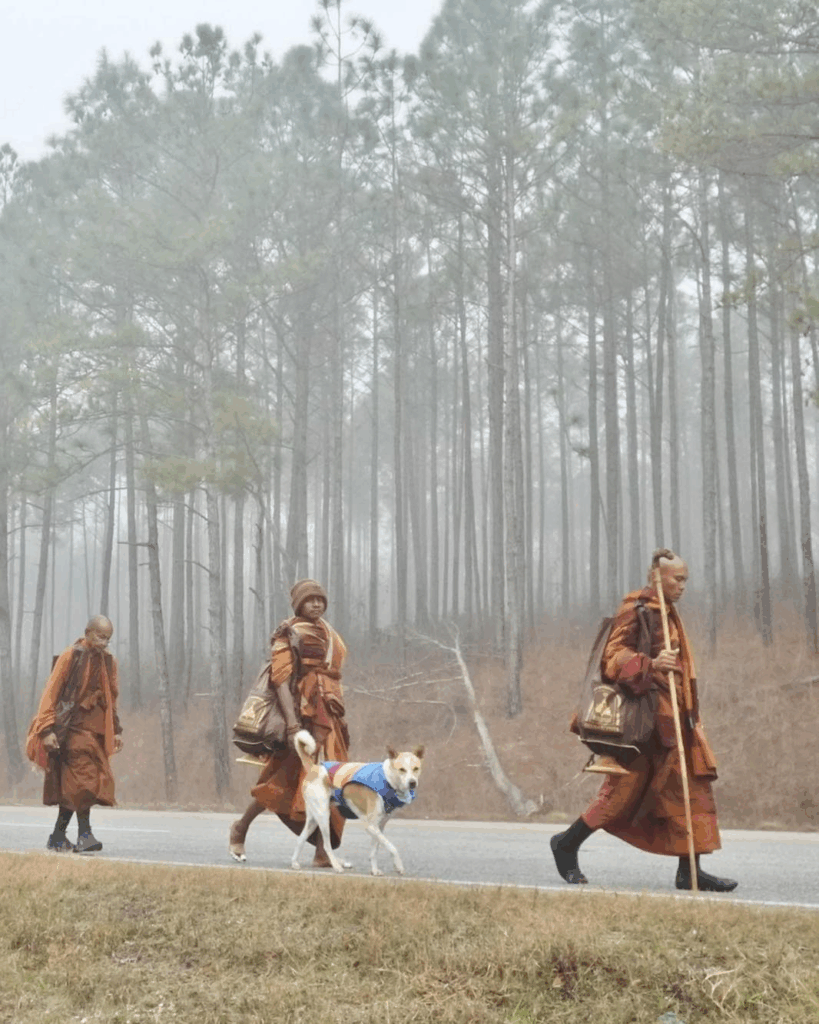
Walking from Texas to Washington, DC is hard. That’s not incidental – it’s essential.
The friction:
- Creates forward motion people can follow
- Invites others to root for progress
- Signals sincerity without explanation
People don’t need to understand Buddhism to understand effort. They don’t need to share beliefs to recognize endurance. Momentum builds because observers want to see the walk continue. That’s branding in motion.
This Was Planned – And That Matters
There’s a temptation to call this “organic” and stop there. But behind the scenes, there is:
- Route coordination across cities and states
- Advance communication with communities
- Live maps tracking progress
- Ongoing photo and video documentation
- A consistent narrative unfolding in real time
This matters because authenticity and strategy are not opposites. The strongest brands do the work to plan carefully – then get out of the way of the message. That matters – because a lot of brands, especially the smaller ones, are reactive. They see something shiny and chase it. Or they think of something far too late – because of lack of planning – and then create a maelstrom of activity trying to get it done – often causing it to land haphazardly and producing weak results. Nothing the monks are doing feels over-produced. There is a lot of elegance in simplicity – because the simplicity was orchestrated. That’s what makes it look easy. Nothing competes with the mission. The structure simply allows the meaning to travel farther.
Timing Is Part of the Message
The walk unfolded throughout the holidays – a season when themes of peace, reflection, generosity, and humanity are already present. The monks didn’t interrupt the cultural moment. They aligned with it. That alignment made the message land more deeply – without force, without commentary, without confrontation.
In a time defined by political hostility, global tension, and constant outrage, they offered a countermessage simply by existing differently in public. Not reactive. Not combative. Just clear.
Clarity Buys Attention. Details Come Later.
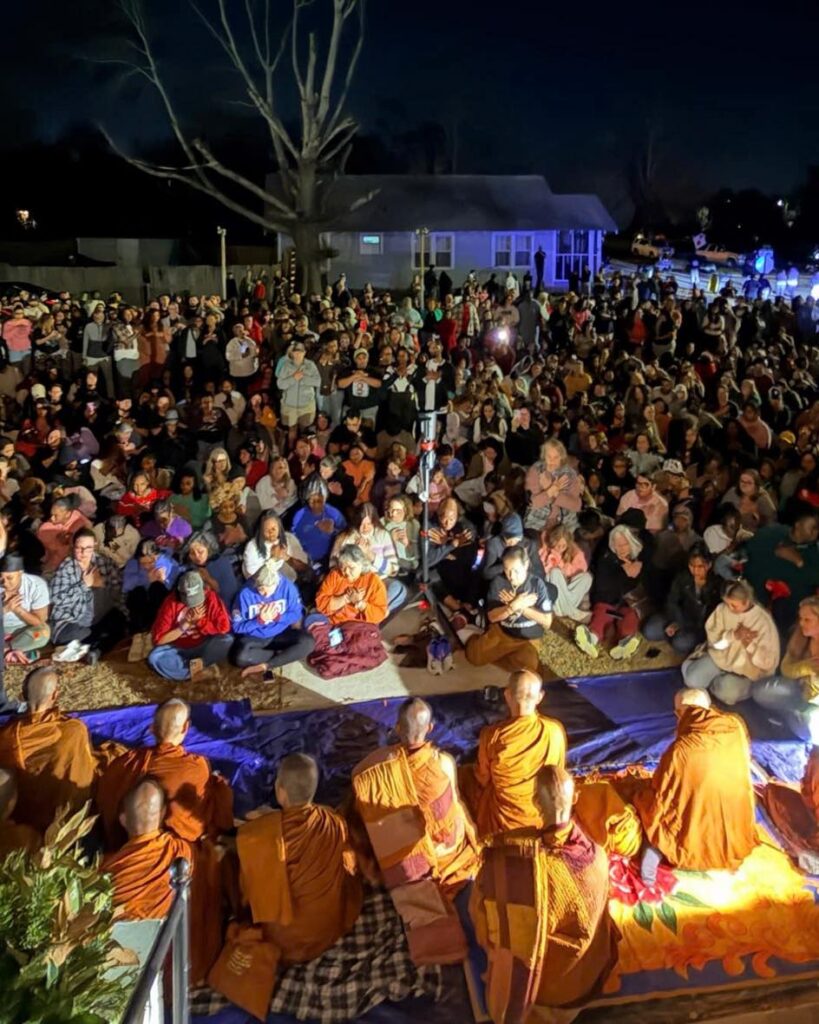
Here’s the part most brands get backward. The monks didn’t abandon complexity. They sequenced it. Because they led with clarity and intrigue, they earned the right to expand. At lunch breaks. In evening talks. In roadside conversations.
That’s where they speak about:
- Mindfulness
- The weight people are carrying
- Suffering, endurance and compassion
People listen – even through broken English – because the platform already exists. They didn’t start with nuance. They earned nuance. Clarity + intrigue buys attention. Consistency builds trust. Trust creates space for complexity.
What Smedium Businesses and Non-Profits Can Learn From This
You don’t need to replicate the walk.
You need to replicate the principle.
1. Choose one message you want to be known for.
Not everything you do. The one idea people should associate with you instinctively.
2. Turn that message into visible behavior.
How do you practice that value publicly and repeatedly?
3. Let people witness progress.
Momentum invites participation more than perfection ever will.
4. Plan carefully – then let the mission speak.
Strategy should support meaning, not overshadow it.
5. Earn the right to explain more later.
Depth is welcomed once trust exists.
The Quiet Genius of Aloka (and Why People Care So Deeply)
There’s another layer to this story that’s impossible to miss once you notice it.
The monks aren’t walking alone.
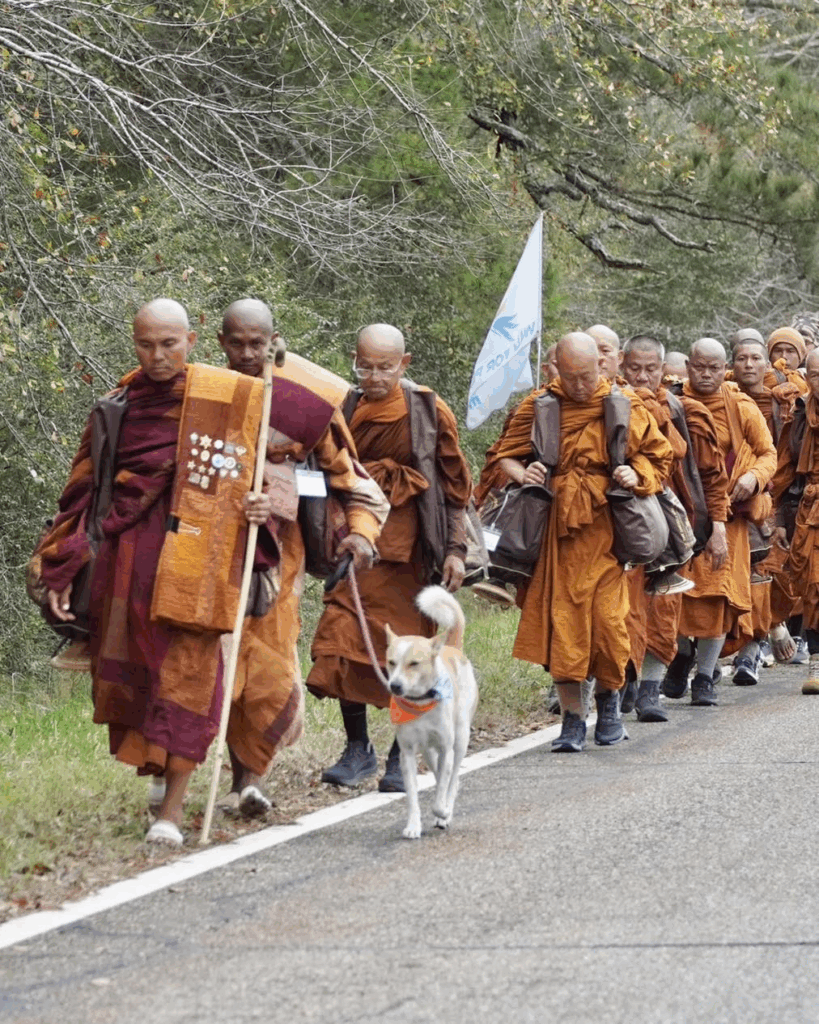
They’re walking with a dog named Aloka – a name associated with enlightenment, illumination, and spiritual awakening. And whether people understand the etymology or not, they understand the feeling.
Aloka has become beloved.
City officials know the dog’s name by the time the walk reaches them.
People ask about the dog’s well-being before anything else.
Strangers offer free services – bathing, paw care, physical treatments – simply because they’re concerned.
The dog has its own social media presence (Aloka the Peace Dog – currently with 76K followers on Facebook). It appears prominently in photos and videos. And people are invested. What’s important here is not novelty – it’s attachment.

Why Aloka Works (From a Branding Lens)
Aloka does several things at once, quietly and effectively:
1. It humanizes the journey. People may hesitate to approach monks. They don’t hesitate to care about a dog.
2. It lowers the barrier to emotional entry. You don’t need to understand Buddhism to worry about a dog’s paws, fatigue or comfort.
3. It gives people a role. Caring for Aloka allows communities to participate without needing belief alignment. That’s powerful.
People don’t just observe the walk – they contribute to it.
This Is Not Reckless – It’s Responsible
It’s also worth saying clearly: this isn’t irresponsible or performative. There is a support system in place.
A trailer follows the group. If Aloka is tired or stressed, the dog rests. And importantly, this isn’t new behavior.
Aloka has reportedly been walking with the monks across countries – including India – for hundreds of miles over time. The dog is accustomed to this rhythm. Which reinforces the larger point: Nothing here feels exploitative. Nothing feels forced. Because the values are consistent.
The “Side Brand” That Strengthens the Core Brand
From a strategic standpoint, Aloka functions as a secondary brand – but one that never competes with the primary message. Peace still leads. Aloka doesn’t dilute the message. Aloka carries it further. This is what many organizations misunderstand about brand extensions and storytelling elements:
Secondary narratives should soften access, not shift focus. The monks didn’t say, “Look at our dog.” They simply allowed the dog to exist – and trusted human empathy to do the rest.
Platform Discipline Matters Here, Too
It’s also telling where this story lives. Despite having an Instagram account with a single post, almost all activity is concentrated on Facebook:
- Facebook Lives
- Ongoing updates
- Community-driven engagement
They didn’t chase platforms. They chose the one that best supports:
- Longer attention
- Community discussion
- Real-time storytelling
That restraint mirrors everything else they’re doing.
What Smedium Businesses Should Take From This
Here’s the translation – because this matters: You don’t need a mascot. You don’t need a “cute angle.”
You don’t need a side story for the sake of one. But you do need to understand this principle:
People connect through care before they connect through ideas.
For founders and organizations, that might look like:
- Highlighting the people impacted by the work, not just the work itself
- Allowing audiences to participate in support, not just consume messaging
- Creating touchpoints that invite empathy without explanation
Aloka didn’t replace the mission. Aloka made it easier to love.
The Bigger Pattern
Singular message → embodied action → earned attention → expanded storytelling.
Even the dog fits inside that sequence. Nothing here is accidental. Nothing is cluttered. Nothing is shouting. And that’s why it’s working.
The Final Takeaway
The most powerful brands aren’t louder. They’re truer. They don’t chase attention. They draw it. And that magnetism – that gravity – comes from alignment between what you say and what you are willing to do long enough for others to notice.
What lessons are you taking away from the monks right now? Let us know in the comments below.







Read the Comments +